
Before you start
- You need the Sales product turned on for your user. Receivables sits in the Sales menu, next to Orders and Payments.
- A staff member who can only work in some outlets only sees those outlets' unpaid orders. To check who sees what, read Giving Your Staff Access to Reports.
- It helps to read Reading the Payments Report first. The Payments report shows money that came in. Receivables shows money that hasn't come in yet.
What a receivable is
A receivable is money a customer still owes you for work you've already accepted. In a laundry, that's usually a hotel, a gym or a company account that sends items now and pays later. It can also be a walk-in customer who paid a deposit and still owes the rest.
The page helps you decide who to chase today. It shows how much is unpaid, who owes it, and how long each bill has been waiting.
Open the Receivables page
- Click Sales.
- Click Receivables.
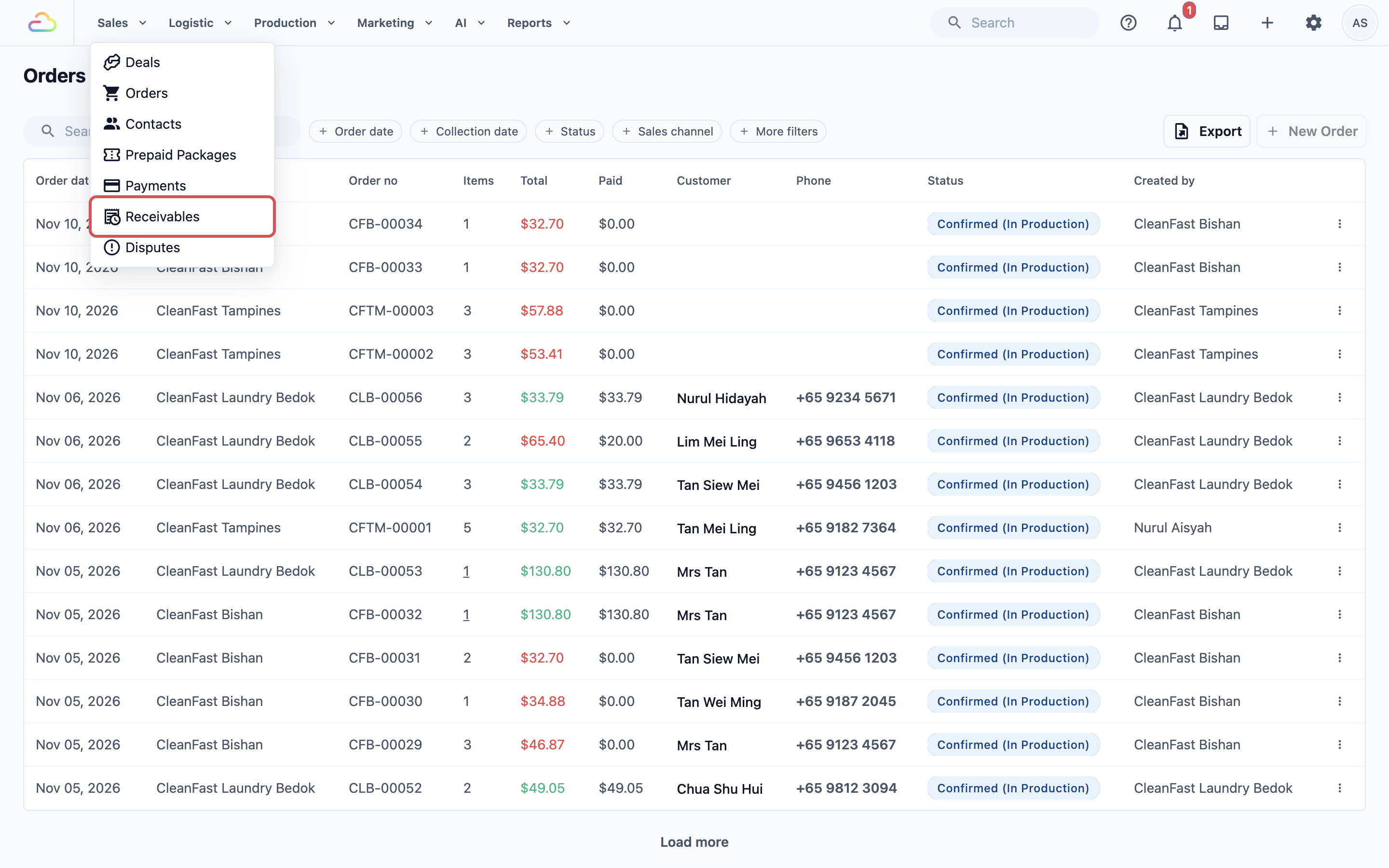
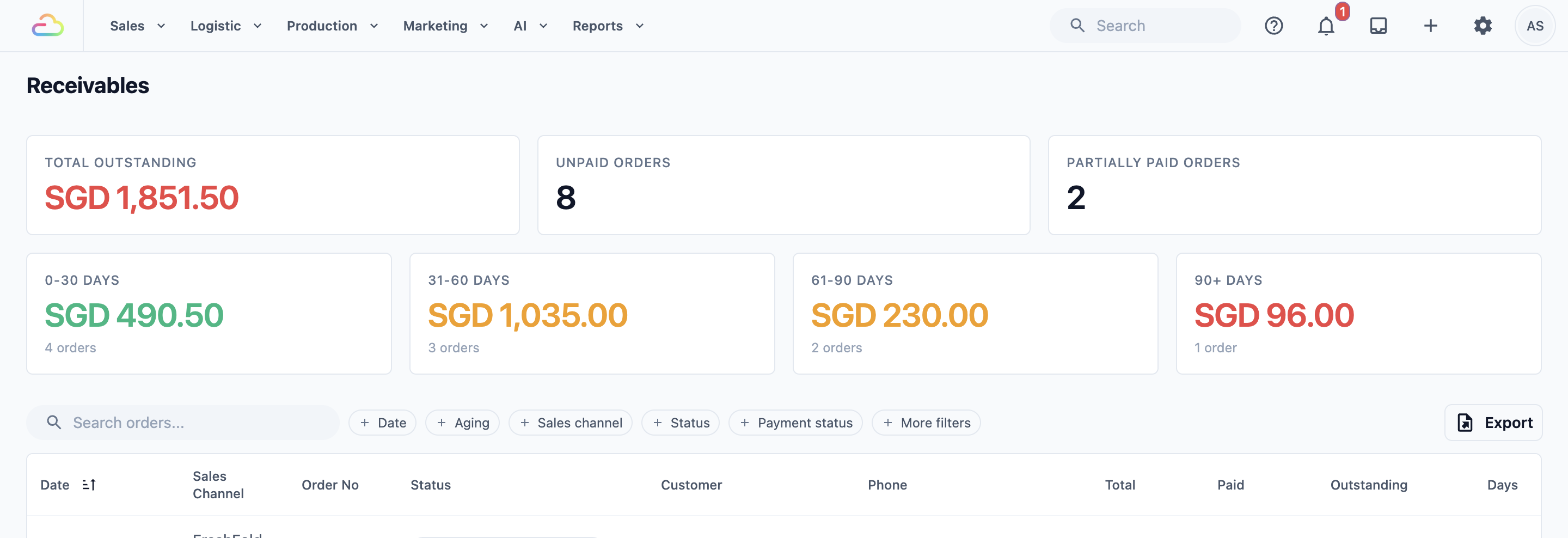
The page opens with two rows of cards above the list.
Read the outstanding and overdue balances
The first row of cards gives you the big picture:
- Total Outstanding: the total amount still owed to you, across all the orders on the page.
- Unpaid Orders: how many orders have no payment at all.
- Partially Paid Orders: how many orders have some payment, but not the full amount.
The second row splits what you're owed by age. Age is counted in days from the day the order was made. This is called aging.
- 0-30 days: recent bills. Most of these will be paid in the normal way.
- 31-60 days and 61-90 days: bills that are getting old. These are worth a reminder.
- 90+ days: bills more than three months old. These need a phone call.
Each card shows the amount owed and how many orders make it up.
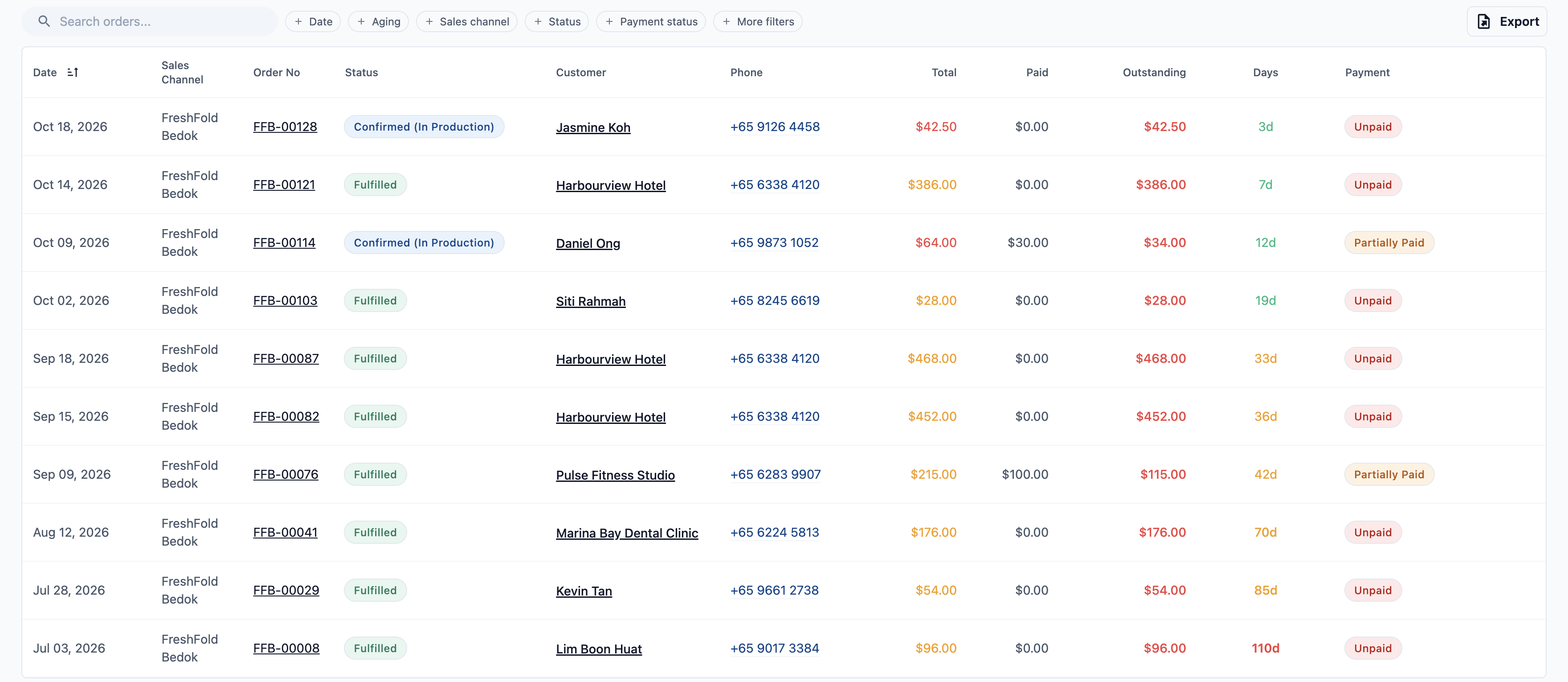
Below the cards is the list itself. Each row is one unpaid order, with these columns:
- Date: the day the order was made.
- Sales Channel: where the order came in, such as your outlet or your online store. A sales channel is any place you take orders.
- Order No, Status, Customer and Phone.
- Total, Paid and Outstanding: what the order costs, what has been paid, and what is still owed.
- Days: how many days since the order was made. It is green while the order is under 30 days old, turns amber from 30 days, and turns red from 90 days.
- Payment: Unpaid or Partially Paid.
Find the bills that need chasing
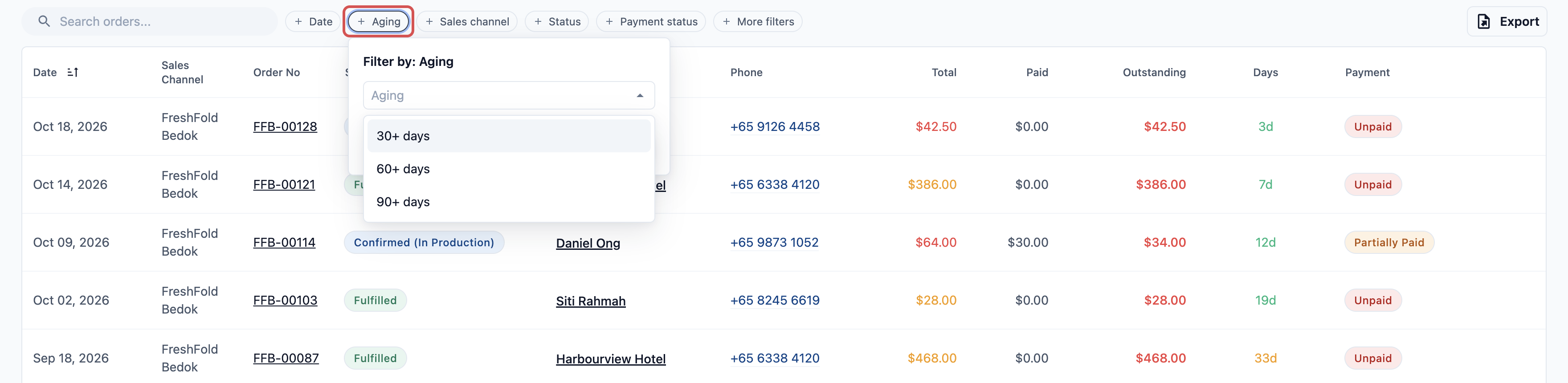
Use the filter buttons above the list to narrow it down.
- Click Aging and choose 30+ days, 60+ days or 90+ days.
- Click Sales channel to see one outlet's unpaid orders.
- To see only orders with no payment, or only part-paid ones, click Payment status and choose Unpaid or Partially Paid.
- To see one customer's unpaid orders, click More filters, then Customer, and type their name.
- To find one order, type its order number in the Search orders... box.
The Total Outstanding, Unpaid Orders and Partially Paid Orders cards change to match your filters. Click Clear filters to see everything again.
To keep a copy of the list as an Excel file, click Export. See Export the Receivables List.
Follow up with a customer
- In the list, click the order number. The order opens.
- Find the Payment section. It shows the Amount Due.
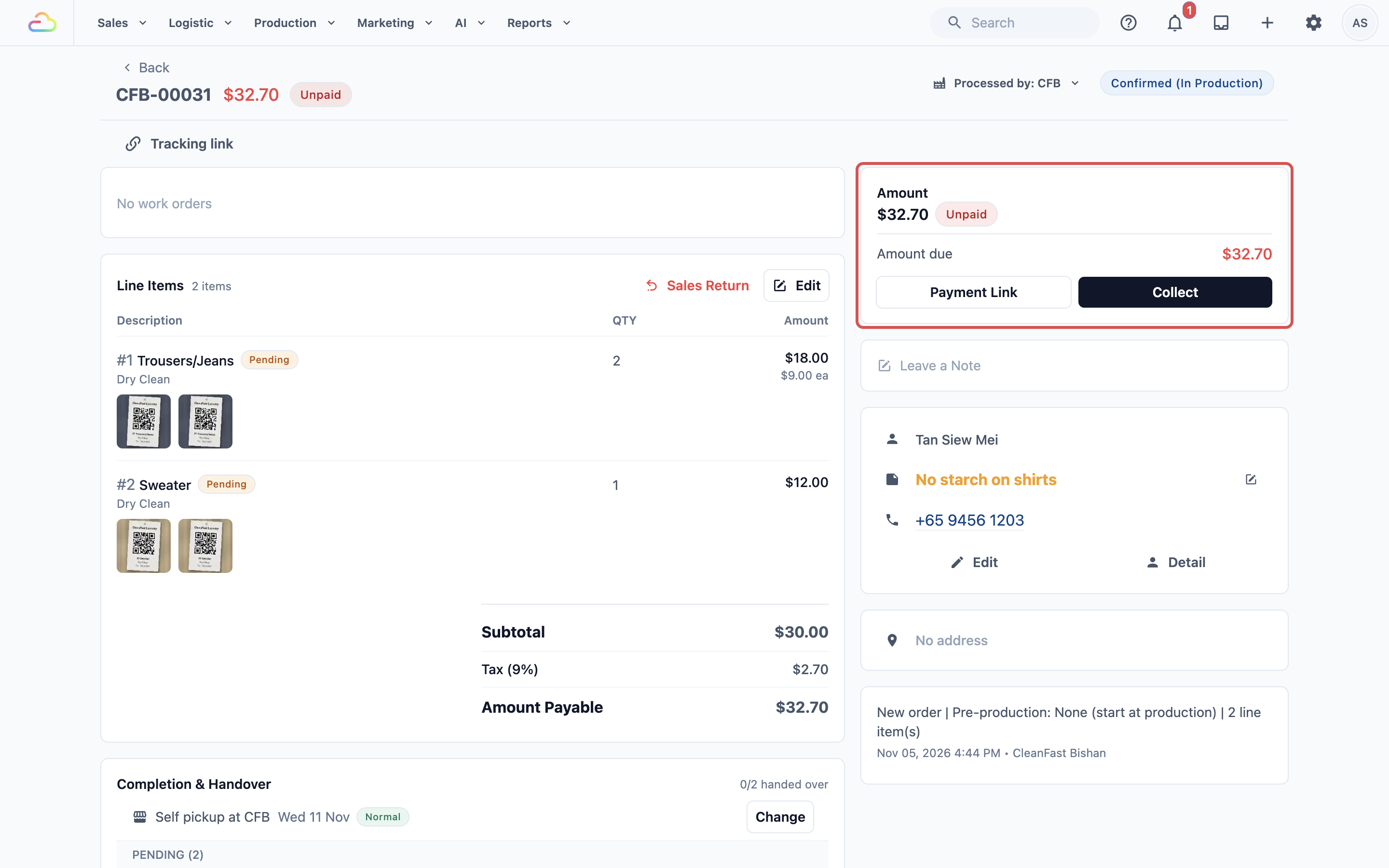
- To remind the customer, click Send Payment Reminder. A message says Payment reminder sent, and the order shows when the reminder went out.
- When the customer pays, click Collect Payment and record the payment.
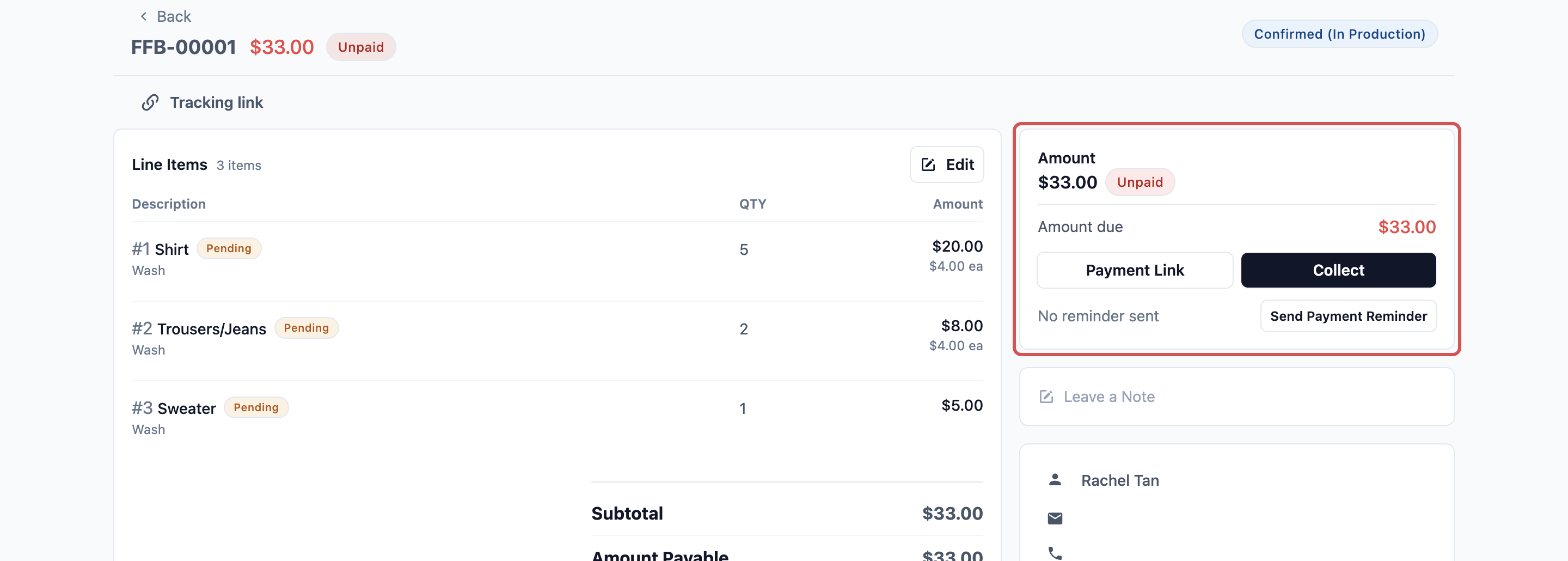
Once an order is fully paid, it leaves the Receivables list by itself.
You only see Send Payment Reminder if your shop has a customer notification set up for the Payment reminder event. You set this up in Settings, under CRM › Customer Notifications. Without it, call or message the customer yourself.
Export the Receivables List
Export the list when you need it outside EasyBiz. For example, you can send a hotel customer a list of the bills it still owes, or give your accountant every unpaid bill at month end. An export saves the list as an Excel file.
- Set the filters above the list to the bills you want, for example one customer or one sales channel. If customers owe you in more than one currency, pick the currency with the buttons above the cards.
- To the right of the filters, click Export.
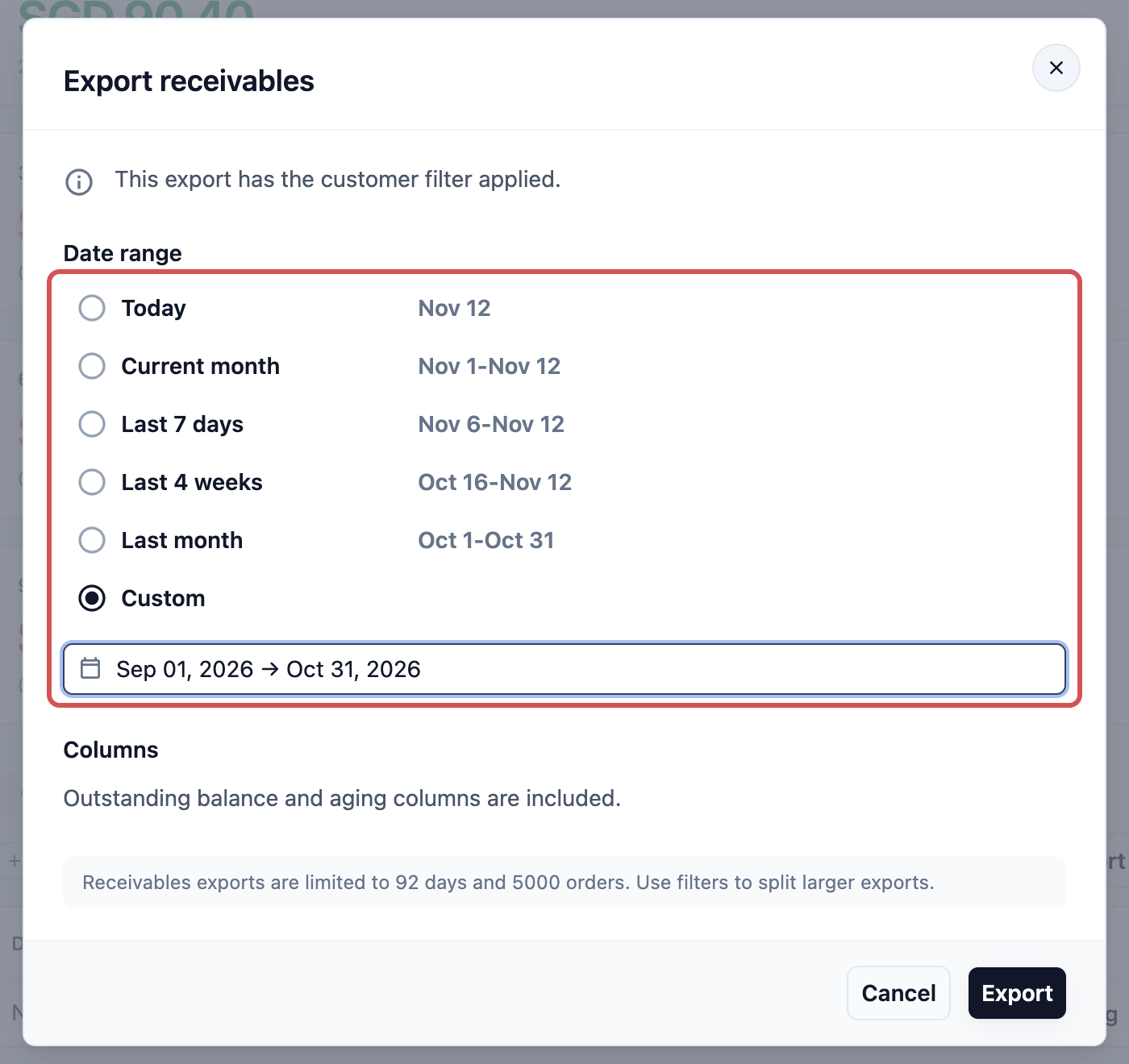
The Export receivables window opens.
- Read the line at the top. It names the filters the file will use, for example "This export has the customer and payment status filters applied." With no filters set, it says "This export uses the current list filters."
- Under Date range, choose which orders to include by the day they were made: Today, Current month, Last 7 days, Last 4 weeks, Last month or Custom. These are the same dates as the Date column.
- Read Columns. It says "Outstanding balance and aging columns are included."
- Click Export.
When Export ready shows under the button, click Download. The file is also kept on your Downloads page, where it is listed as Order Export. See Exporting to Excel and Downloads.
What carries over from the page
| Filter on the page | In the export |
|---|---|
| Currency buttons | The file has only the orders owed in the currency you picked |
| Sales channel | The same sales channels |
| Status | The same status. With no status picked, the file has both Confirmed and Fulfilled orders |
| Payment status | The same payment status. With none picked, the file has both Unpaid and Partially Paid orders |
| Customer | Only that customer's orders |
| Search orders... box | Only the orders that match your search |
| Date | Fills in Custom with the same dates. You can change them in the window |
| Aging | Sets the end of the date range, for example 30 days before today for 30+ days. Choose the start date under Custom. If you pick other dates in the window, the file follows the dates you pick |
What's in the file
The file has one sheet, Receivables, with one row for each unpaid or part-paid order. Its columns are Date, Sales Channel, Order Number, Status, Customer, Phone, Total, Paid, Outstanding, Days Outstanding and Payment Status. Days Outstanding counts from the day the order was made, the same as the Days column on the page. The file is named after its dates, for example receivables-2026-09-01-to-2026-10-31.xlsx.
One export covers up to 92 days and 5,000 orders. The grey note at the bottom of the window says so. If your range is longer than 92 days, a red note shows and Export stays greyed out. If more than 5,000 orders match, the export fails. Add a filter, such as Sales channel, or choose a shorter range, and export in parts.
Example: FreshFold chases a hotel customer
FreshFold Laundry washes towels and bed sheets for Harbourview Hotel. The hotel pays at the end of each month. On Monday, the owner, Mei Ling, sees $1,840.00 on the 31-60 days card. That's more than she expected.
- Mei Ling clicks Sales, then Receivables.
- She clicks Aging and chooses 30+ days.
- She clicks More filters, then Customer, and types Harbourview Hotel.
- The list shows four orders from early last month. The Days column shows 33 to 38 days, in amber. Total Outstanding shows $1,840.00.
- She clicks the oldest order and clicks Send Payment Reminder.
- To send the hotel a list of what it owes, she goes back to the list and clicks Export. She chooses Custom, picks the first and last day of last month, and clicks Export. The file lists the same four orders, with $1,840.00 in the Outstanding column. She emails it to the hotel's accounts team.
Two days later, the hotel pays $1,000.00 for its two oldest orders. Mei Ling opens each order and clicks Collect Payment to record what was paid. The oldest order is now fully paid, so it drops off the list. The second was only part paid, so it stays on the list as Partially Paid, with the rest under Outstanding. Mei Ling knows exactly how much to ask for next.
FAQs
Does a part payment clear the order from Receivables?
No. The order stays on the list as Partially Paid until the full amount is paid. The Days count doesn't restart either. It still counts from the day the order was made, so an old bill stays easy to spot.
Are corporate invoices included?
Yes, through their orders. Receivables lists orders, not invoices, so a monthly invoice shows up as the separate orders inside it. When you record a payment on the invoice in Invoicing, EasyBiz pays off the oldest orders first, and those orders leave the list. The Days column counts from each order's date, not the invoice date.
Why don't the aging cards change when I choose a date?
The four aging cards always show everything that's owed, so you never lose sight of old bills. They ignore the Date and Aging filters, but they do follow the Sales channel, Status, Payment status and Customer filters. The three cards at the top follow every filter.
Can staff without Sales figures & reports open Receivables?
Yes. Receivables follows the Sales switch, not Sales figures & reports. Anyone who can take orders can see who owes you. If a staff member can only work in selected sales channels, they only see those outlets' unpaid orders.
Why is a customer's order missing from the list?
Only Confirmed and Fulfilled orders appear. If an order is still a draft or a quote, confirm it first. A cancelled order never appears, even if it was never paid.
Why do I only see one currency?
If customers owe you in more than one currency, for example SGD at your Singapore outlets and MYR at your Malaysia outlets, the page shows one currency at a time. Amounts in different currencies can't be added together. Pick the currency with the buttons above the cards, such as Singapore · SGD. The cards, the list and any export then show only the orders owed in that currency.
Why is my Receivables file called Order Export on the Downloads page?
Receivables is built from your orders, so the Downloads page lists its file as Order Export. The file itself is named receivables with its dates, and its sheet is called Receivables.
Can I export a whole year of one customer's unpaid bills?
Not in one export. A Receivables export covers up to 92 days, even when you filter to one customer. Export the year in parts of up to 92 days. The Orders list allows up to a year for one customer, but its file includes paid orders too.
What's next
Continue to Reading the Contacts Report to see who your customers are and how many are new.