
To add a business unit, go to ⚙️ Settings › Business Units, click New Business Unit, type its Display name, optionally choose a Business type, and click Create. You can rename it or add a code and icon later with ⋮ › Edit. When you stop offering a service, archive the unit with ⋮ › Archive. Business units can't be deleted.
Before you start
Read Introduction to Business Units first. It explains what a business unit is and when a service needs its own.
Also write down the services you plan to split into business units. For example, CleanFast Laundry lists 2: Laundry, priced per kg, and Bag Repair, priced by quote after an inspection. Create one business unit for each service on your list.
Only the owner, or staff with the Company & business structure admin access, can create, archive or unarchive a business unit, or change its name, code and icon.
Create a business unit
- In the Console (the EasyBiz back office you open in a web browser), click ⚙️ Settings.
- Under Company & business structure (or Administration), click Business Units.
- Click New Business Unit. If you have no business units yet, the page shows "No business units yet" with the same button in the middle.
- In Display name, type the name of the service, for example Bag Repair.
- Optional: in Business type, choose the kind of business, or leave it as "None: I'll set it up myself". See "Choosing a business type" below.
- Click Create.
EasyBiz opens your new business unit straight away. Its name appears at the top of the page, with the tabs below it.
Display name
Use the name your staff and customers already use for the service. Keep it short and clear, such as Laundry, Dry Cleaning or Bag Repair. The name can be up to 120 characters. If you type more, the field shows "Use 120 characters or fewer." and the Create button stays greyed out.
If you choose a business type before you type a name, the name is filled in with the type's name. You can change it.
Choosing a business type
A business type gives the new unit a head start. The choices are:
- Laundry
- Bag Service
- Upholstery Cleaning
- Aircon Service
- Home Cleaning
- Other service: any other service. It starts with an empty catalog, so you add the services you sell yourself.
With a business type, the unit starts with its starter services, service options, booking checkout and a draft price list. Laundry, Aircon Service and Home Cleaning also start with their order steps, so new orders move through the right steps from day one. When it's ready, you see "Business unit created with its starter services. Review its prices in Price Lists and publish them." Check the starter prices in ⚙️ Settings › Price Lists and publish them before you sell.
With None: I'll set it up myself, you see "Business unit created", and the unit starts empty: no code, no icon, no prices and no checkout steps. You set up each tab yourself.
For a full picture of what a type sets up, see Running a Home Cleaning Business on EasyBiz and Running an Aircon Service Business on EasyBiz.
Let staff sell the new unit
A new business unit isn't offered to staff everywhere on its own. Before staff can use it:
- Set up what it sells on its Catalog tab. See Choosing What You Sell and Your Prices.
- Turn it on where staff take orders. Each POS app's Checkout page, and the Console's Checkout page (New Order), has a list called Business units shown in POS. If a list names its units, a new unit shows there switched off until you turn it on. See Choosing Which Business Units Staff Can Sell.
Until the unit has a catalog, the POS shows "This business unit has no catalog."
Edit the name, code and icon
You give a business unit its code and icon after you create it. You can also come back at any time to rename it.
- Go to ⚙️ Settings > Business Units.
- If you have more than 1 business unit, click the one you want to change at the top of the page.
- Click the ⋮ menu next to the business unit's name.
- Click Edit.
- Change any of the 3 fields below.
- Click Update.
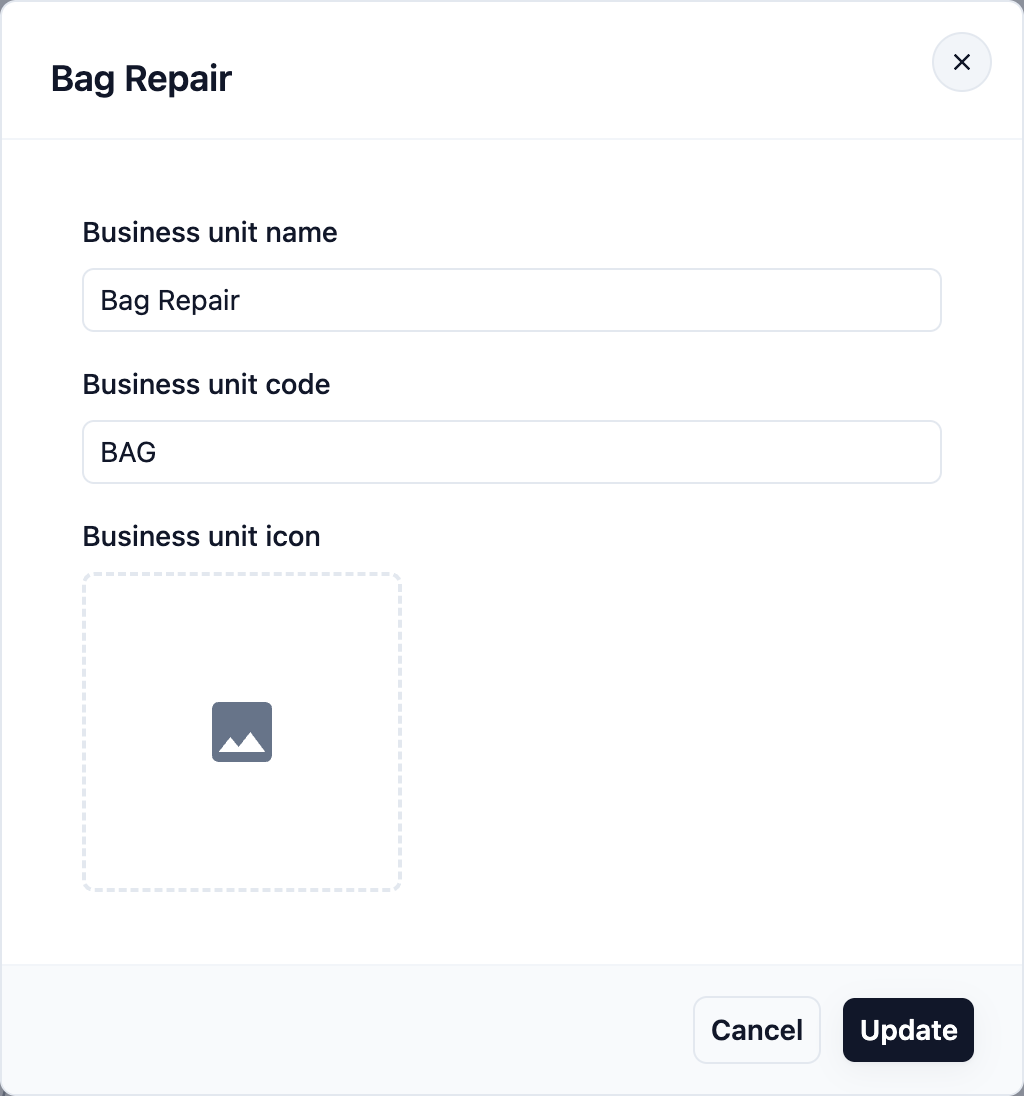
The Update button only becomes active after you change something. Once saved, you see "Business unit profile updated".
Business unit name This is the same name you typed when you created the unit. It's required, so you can't leave it empty. It can be up to 120 characters.
Your staff see this name:
- On the POS (the EasyBiz app your staff use at the shop counter), when they switch between business units for an order.
- On receipts, invoices and labels that show the business unit name.
- In your reports, when you filter by business unit.
- In the Business units shown in POS list of each POS app's Checkout page and the Console's Checkout page.
Business unit code
A short code is a quick label for the business unit, such as LD for Laundry or BAG for Bag Repair. It's optional. Use a few capital letters that your team recognises at a glance.
The code shows under the unit's name on the Business Units page. It does not appear on the POS, and it is not added to your order numbers. If you want it on paper, you can add Business Unit Code to your receipt or label template. See Choosing Your Receipts, Invoices and Labels.
Business unit icon
The icon is a small picture for the business unit, such as a bag for Bag Repair or a washing machine for Laundry. It's optional.
- Click the picture box under Business unit icon.
- In the Media Center window, click Upload image to add a new picture, or pick one you uploaded before.
- Click Choose image.
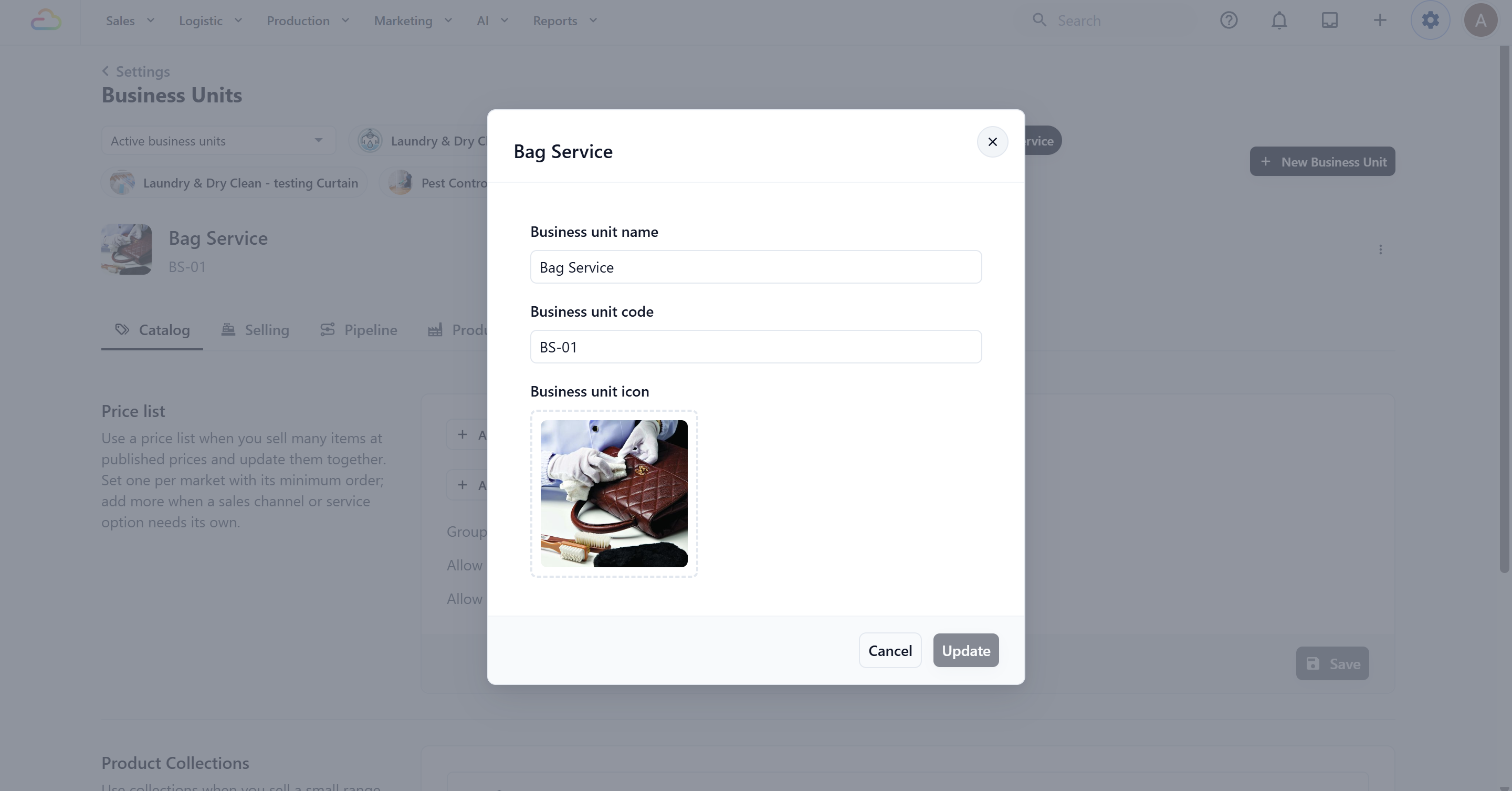
The icon shows next to the unit's name on the Business Units page. It helps you find the right unit quickly when you run several. The POS shows the name only, not the icon.
Example: adding Bag Repair at CleanFast Laundry
CleanFast Laundry already runs a Laundry business unit. The owner starts offering bag repairs and sets up a new unit:
- Display name: Bag Repair
- Business type: Bag Service, so the unit starts with bag services
- Business unit code: BAG (added afterwards with Edit)
- Business unit icon: a simple handbag picture
After saving, the Business Units page shows 2 buttons at the top: Laundry and Bag Repair, each with its icon. Bag Repair shows BAG under its name.
The owner checks Bag Repair's Catalog and Pipeline tabs. Then the owner opens the shop's POS app, goes to its Checkout page and turns Bag Repair on under Business units shown in POS. Staff at the counter now see a business unit switcher above the item list on the POS. They pick Laundry for a bag of clothes and Bag Repair for a handbag.
Archive a business unit you no longer offer
You can't delete a business unit, because your past orders, reports and settings still point to it. When you stop offering a service, archive it instead:
- Go to ⚙️ Settings > Business Units and click the unit.
- Click the ⋮ menu next to its name and click Archive.
- Read the message and click Archive.
You see "Business unit archived". From then on:
- Staff can no longer choose it for new orders.
- Customers can no longer book it online.
- Past orders, reports and its settings stay as they are.
You can't archive your last active business unit. Every account keeps at least one.
See or bring back an archived unit
- At the top of the Business Units page, change the filter from Active business units to Archived business units.
- Click the unit. It shows an Archived label next to its name.
- Click the ⋮ menu and click Unarchive.
You see "Business unit unarchived". While a unit is archived, its name, code and icon can't be edited. Unarchive it first.
FAQs
If I rename a business unit, do my old receipts change?
No. Each order keeps the business unit name it had when it was created. Reprinting an old receipt shows the old name. New orders, the POS and your reports use the new name. The business unit code works differently: it always shows the latest code, so a reprinted receipt with Business Unit Code on it shows the new code.
Can I hide a business unit I've stopped selling?
Yes. Archive it, and it disappears from new orders everywhere and from your Online Store. If you only want to stop selling it at one POS, switch it off under Business units shown in POS on that POS app's Checkout page instead. See Choosing Which Business Units Staff Can Sell.
Can I delete a business unit?
No. Archive it instead. An archived unit takes no new orders, but its past orders and reports stay, and you can unarchive it at any time.
Does the business unit code appear on order numbers?
No. Order numbers come from each shop's own running number, not from the business unit. If you want staff and customers to see the code, add Business Unit Code to your receipt or label template.
I created a new business unit. Why can't my staff see it on the POS?
Check 2 things. First, turn it on under Business units shown in POS on the POS app's Checkout page, and on the Console's Checkout page if staff take orders in the Console. Second, set up its Catalog tab. Until it has a catalog, the POS shows "This business unit has no catalog." See Choosing What You Sell and Your Prices.
My staff took orders for a new unit and they stay at Confirmed with no steps. Why?
The unit's order steps were never saved. Its Pipeline tab shows Not set up on the Production card. Click Save on that card. New orders then get their steps.
Why can't my staff member see the New Business Unit button or the Edit and Archive options?
Only the owner and staff with the Company & business structure admin access can create, archive or unarchive a business unit, or change its name, code and icon. Other staff can still open the tabs they have access to.
Do I pay extra for each business unit I create?
No. There's no separate charge for each business unit. Your EasyBiz plan and staff seats are billed the same way however many business units you have.
What's Next
You've created your business unit and given it a name, code and icon. Next, choose what it sells and how much it costs in Choosing What You Sell and Your Prices.